Ghana Government Salary Structure: How Your Salary Is Calculated
Ever checked your GoG ePay Services payslip and wondered how your salary is actually calculated? Or why someone with the same job title earns a different amount? Many public sector employees in Ghana also wonder why annual salary increases and promotions don’t always appear on their payslips right away.
This guide explains how the Ghana Government Salary Structure works, how your salary is calculated, what affects your monthly pay, and when you can expect a salary increment or promotion to be reflected on your GoG ePay Services payslip.
How Is Ghana Government Salary Calculated?
Your salary as a Ghana government employee is not decided randomly. It follows the Single Spine Salary Structure (SSSS), which provides a standard pay framework for public sector workers.
The amount you receive each month depends on four main factors:
- Your grade level and step, which determine your basic salary.
- Approved allowances, which are added to your basic salary where applicable.
- Statutory deductions, such as SSNIT and PAYE tax.
- Other payroll deductions, including loan repayments, union dues, or welfare contributions if they apply.
In simple terms, your monthly salary is calculated like this:
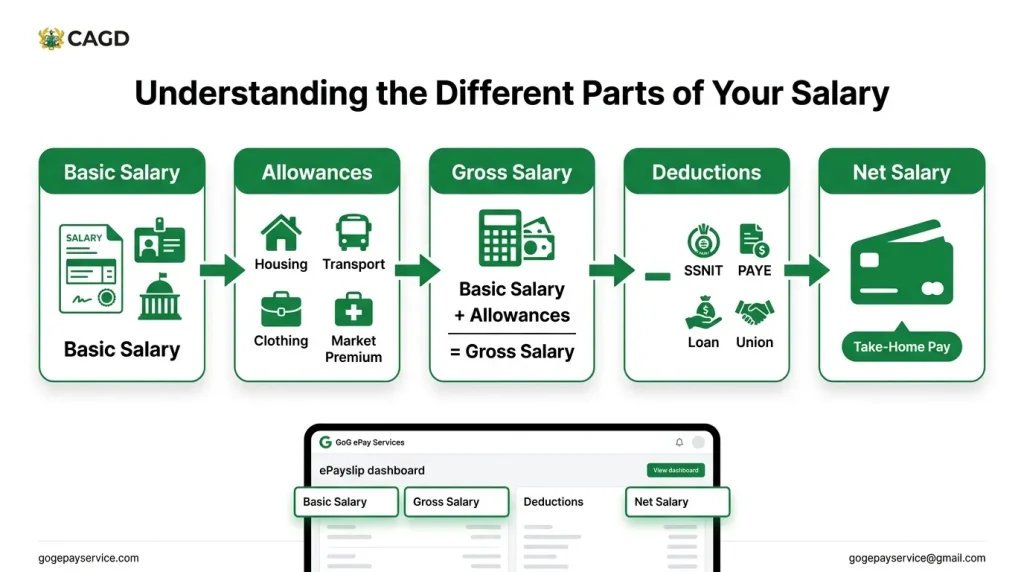
Basic Salary + Allowances = Gross Salary
Gross Salary − Deductions = Net Salary
Once the Controller and Accountant-General’s Department (CAGD) processes payroll, this complete breakdown appears on your monthly GoG ePay Services payslip.
Understanding the Different Parts of Your Salary
Now that you know how your salary is calculated, it’s helpful to understand what each amount on your payslip actually means.
Basic Salary
Your basic salary is the fixed amount assigned to your grade level and step under the Single Spine Salary Structure. It forms the foundation of your monthly earnings and is used to calculate certain deductions, including your SSNIT contribution.
Allowances
In addition to your basic salary, many public sector employees receive approved allowances. These may include housing, transport, clothing, or profession-specific allowances. Some occupations, such as teachers, doctors, and engineers, may also receive a market premium to help keep salaries competitive.
Gross Salary
Your gross salary is your total earnings before any deductions are made.
Gross Salary = Basic Salary + All Approved Allowances
Deductions
Before your salary is paid, several deductions may be taken from your gross earnings. Common deductions include:
The deductions shown on your payslip depend on your individual circumstances.
Net Salary
Your net salary is the final amount deposited into your bank account after all deductions have been made. This is commonly referred to as your take-home pay.
Example of How a Government Salary Is Calculated
The example below shows how these components fit together. The figures are for illustration only and do not represent the official salary for any specific grade.
Salary Component | Example Amount |
Basic Salary | GH₵3,500 |
Housing Allowance | GH₵250 |
Transport Allowance | GH₵150 |
Gross Salary | GH₵3,900 |
SSNIT (5.5% of Basic Salary) | GH₵192.50 |
PAYE Tax | Based on the applicable tax band |
Other Deductions | Depends on the employee |
Estimated Net Salary | Gross salary minus all deductions |
Although every employee’s salary will differ depending on their grade, step, allowances, and deductions, the calculation process remains the same for everyone under the Single Spine Salary Structure.
What Is the Single Spine Salary Structure?
The Single Spine Salary Structure (SSSS) is the salary system used to pay public sector employees in Ghana. It covers workers such as teachers, nurses, police officers, and civil servants. The system was introduced in July 2010 and is managed by the Fair Wages and Salaries Commission (FWSC).
Before the SSSS was introduced, different government institutions used different pay scales, so people doing similar jobs could earn different salaries. The SSSS created one common salary structure for the public sector, where your pay is mainly based on your grade level, step, and any approved allowances rather than the government institution you work for.
How the Salary Structure Is Organized
The SSSS runs from Level 1 to Level 25. Level 1 covers entry-level positions, and Level 25 covers the most senior roles in the public service.
Within each level, there are several steps. As an example, the Civil Service’s own induction materials show Level 1 having steps 1 through 9, while higher levels have fewer steps. Where exactly you sit, your level and your step, is what determines your basic pay figure on the SSSS chart.
Your level is tied to your job grade. Your step reflects where you currently are within that grade, and it changes mainly through promotion rather than staying fixed forever.
How and When the Annual Base Pay Adjustment Happens
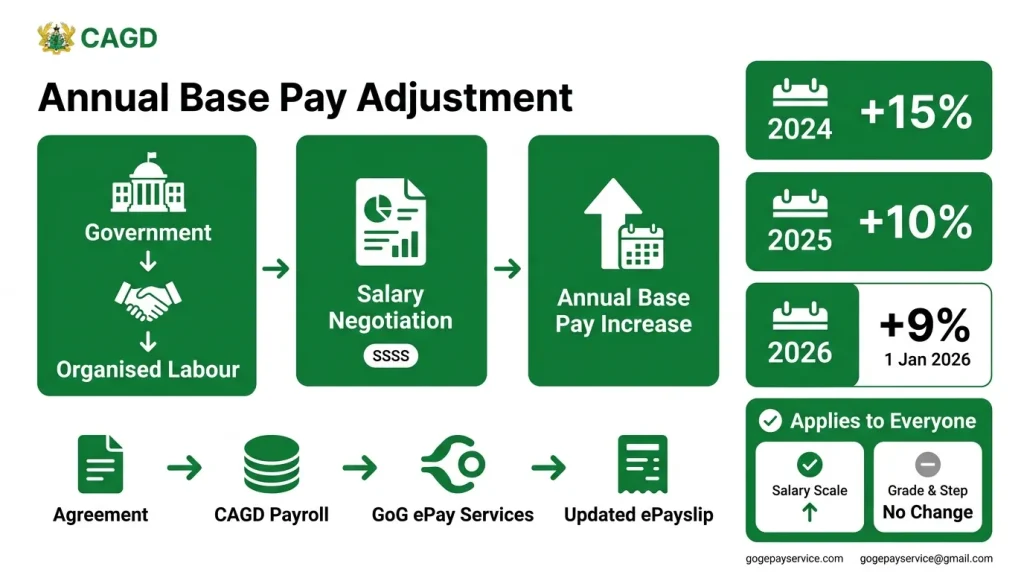
The Ghana Government reviews public sector salaries regularly through an Annual Base Pay Adjustment. During this process, the government and Organised Labour, including the Trades Union Congress (TUC) and other public sector unions, negotiate a percentage increase to the Single Spine Salary Structure (SSSS).
Recent Annual Base Pay Increases
Recent adjustments include:
When Does the Increase Take Effect?
There is no fixed date for the annual adjustment. In some years, the increase starts in January, while in other years it may be announced later because of government budget negotiations.
Once an agreement is reached, the Controller and Accountant-General’s Department (CAGD) updates the payroll system, and the new salary appears on your payslip.
Important: The annual base pay adjustment increases the salary scale for everyone on the Single Spine Salary Structure. It does not change your grade level or step. Promotions are handled separately.
How Promotion Affects Your Salary
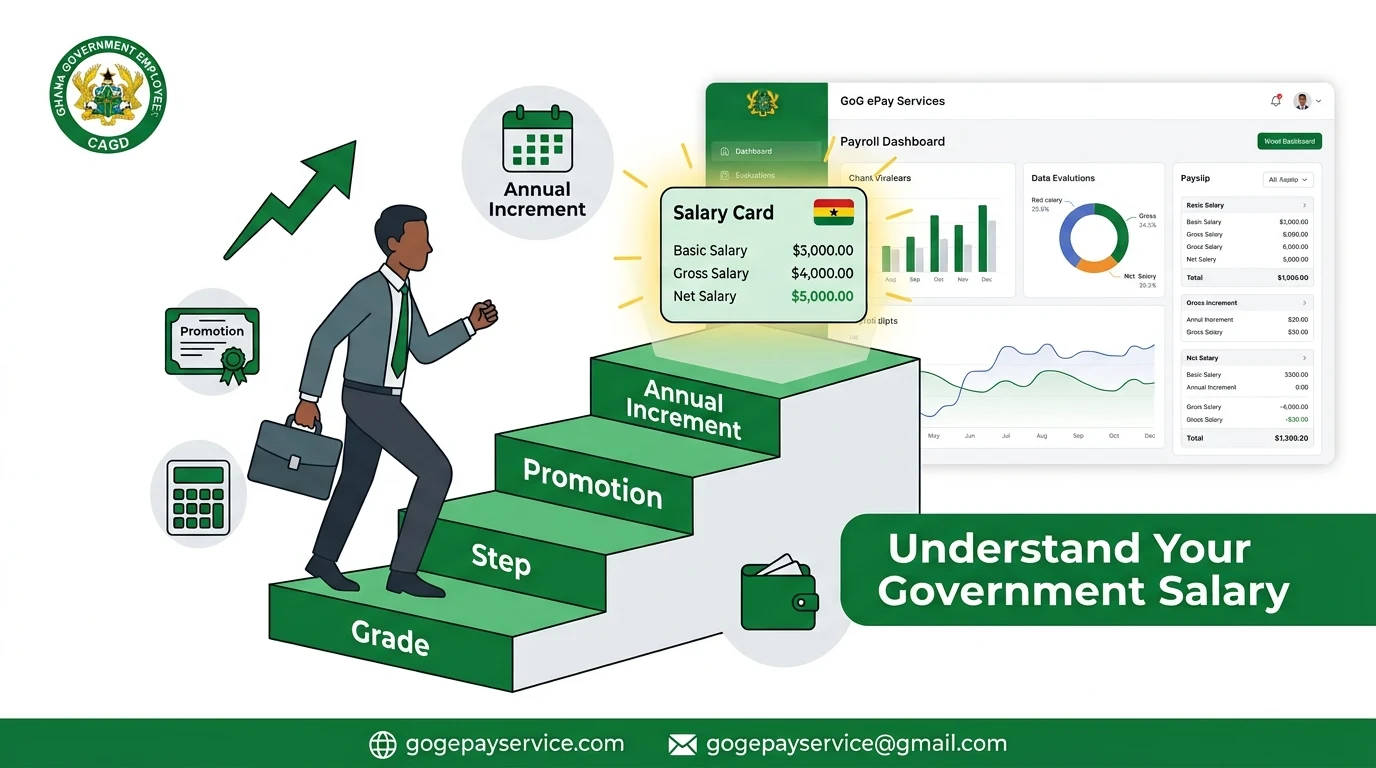
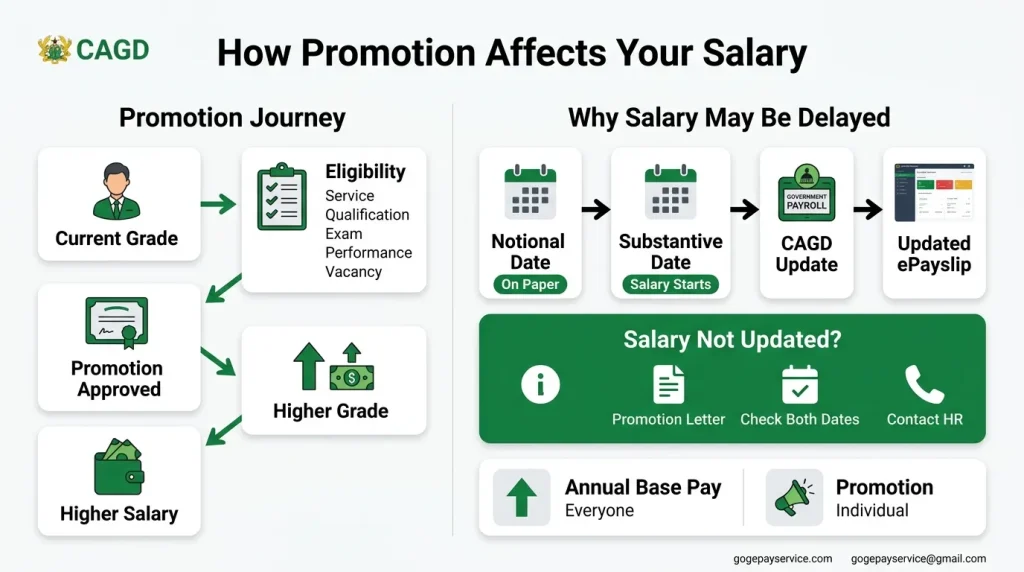
While the annual base pay adjustment increases salaries for everyone, promotion increases your own salary by moving you to a higher grade or level on the Single Spine Salary Structure.
Who Is Eligible for Promotion?
The exact requirements depend on your institution, but you will usually need to:
For example, teachers in the Ghana Education Service (GES) are generally required to pass the Promotion Aptitude Test before they can be promoted.
Why Hasn’t My Salary Changed After Promotion?
Many employees expect their salary to increase immediately after receiving a promotion letter, but this is not always the case.
A promotion letter often includes two important dates:
These dates can sometimes be months or even a year apart. After your substantive date, the Controller and Accountant-General’s Department (CAGD) must also update the payroll before the higher salary appears on your payslip.
Tip: If your salary has not changed after a promotion, check both dates on your promotion letter before reporting the issue to your HR or payroll office.
Where to Check Your Current Grade and Salary
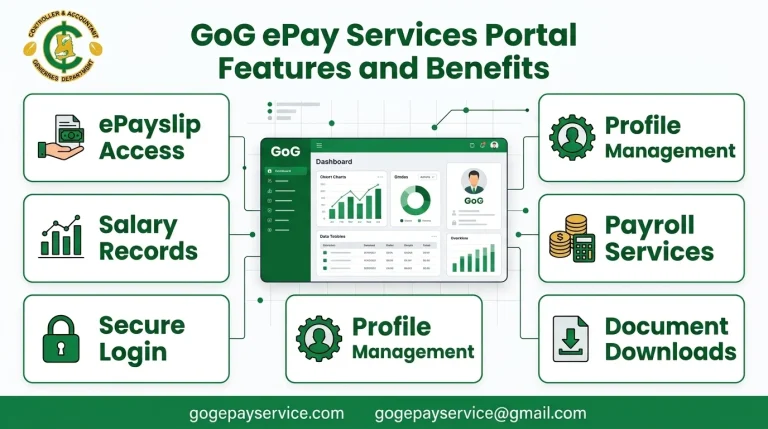
The easiest way to confirm your current salary is by checking your monthly GoG ePay Services payslip. Once CAGD updates your payroll, your latest basic salary, allowances, deductions, and net pay should appear on your payslip.
Reviewing your payslip regularly also helps you:
If you notice a difference between your expected salary and your payslip, contact your payroll office or HR department so they can investigate the issue with CAGD if necessary.
Conclusion
Understanding the Ghana Government Salary Structure makes it easier to read your GoG ePay Services ePayslip and understand why your salary changes over time. Your monthly pay is based on your grade, step, approved allowances, statutory deductions, annual base pay adjustments, and any promotions processed through the Controller and Accountant-General’s Department (CAGD).
If your salary does not match what you expect, review your latest GoG ePay Services ePayslip to check your basic salary, allowances, and deductions. Most salary differences are caused by annual base pay adjustments, promotion processing timelines, or payroll updates. By understanding how the Single Spine Salary Structure works, you’ll be able to spot changes more easily and identify any payroll issues before contacting your HR or payroll office.