Ghana PAYE Tax & Net Salary Calculator (2026)
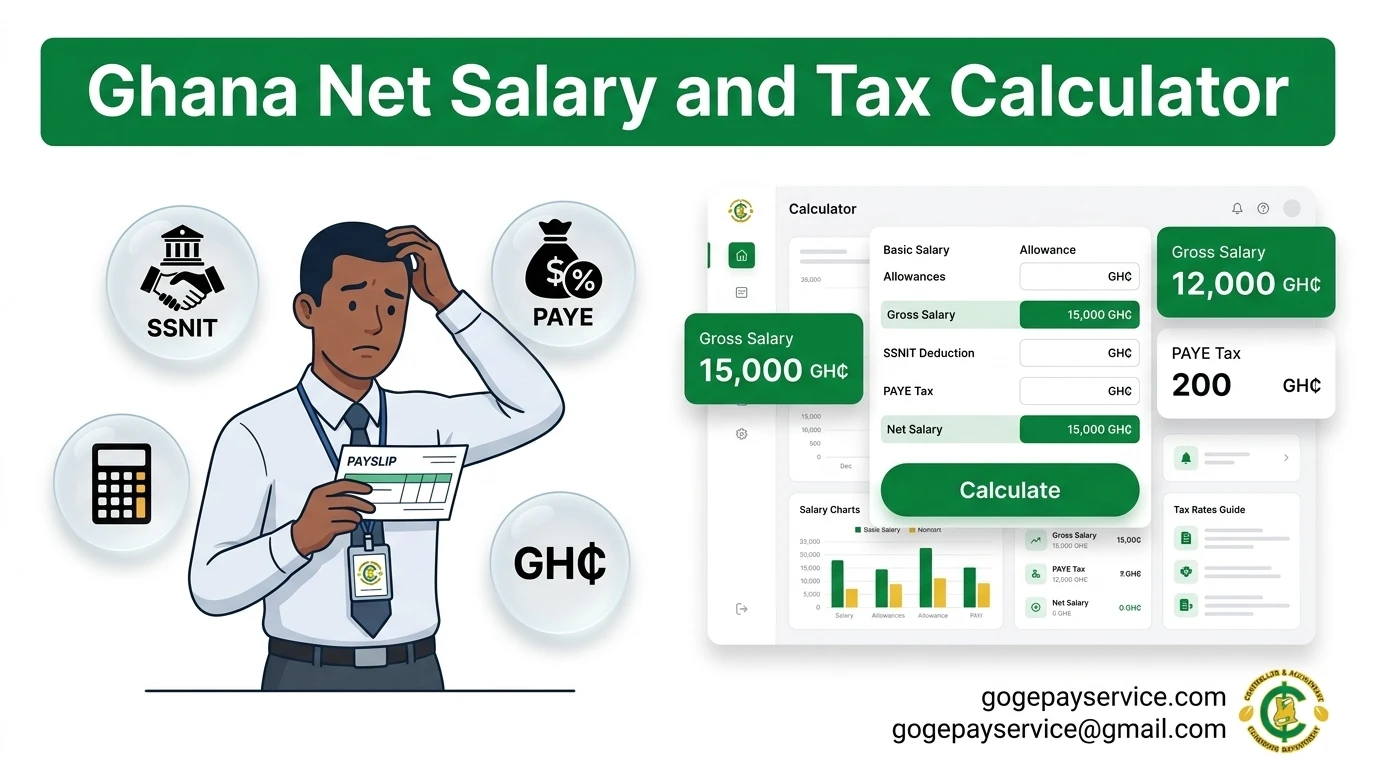
Enter your basic salary and any taxable allowances to see your SSNIT deduction, total tax, and actual net salary. Based on 2026 GRA tax bands and SSNIT rates.
| Band | Taxed at | Tax in band |
|---|
1. SSNIT takes 5.5% of your basic salary. This is your pension contribution. It does not touch your allowances, only your basic pay.
2. Your remaining income is then taxed using GRA’s official tax bands. The first ₵490 you earn each month is completely tax free. After that, the tax rate goes up in steps as your income rises, from 5% on the next small portion, up to 35% on the highest portion for very high earners.
3. What is left after SSNIT and tax is your net pay, the actual amount that lands in your account.
A note on what this tool does not include: it does not factor in Tier 3 pension savings, mortgage interest relief, non taxable allowances, or the SSNIT ceiling that only applies to very high basic salaries above roughly ₵61,000 a month. These can lower your tax further, so your real payslip may show slightly less tax than this estimate. Always treat your official payslip on the GoG ePay Services portal as the final word.
Rates verified: July 2026.
Many government employees in Ghana expect to receive their full basic salary, but the amount that reaches their bank account is usually lower. When you check your salary on the GoG ePay Services Portal, you’ll see deductions like SSNIT and PAYE tax, which are taken from your salary before you are paid.
Our free Ghana Net Salary and Tax Calculator helps you understand the figures shown on your GoG ePay Services Portal ePayslip. Simply enter your basic salary and any allowances to see your SSNIT deduction, PAYE tax, total deductions, and estimated net salary in a clear and easy-to-read breakdown.
How Income Tax Calculator Works in Ghana?
Ghana runs a progressive PAYE (Pay As You Earn) system. This simply means you don’t pay one flat tax rate on your whole salary. Instead, your income is split into bands, and each band is taxed at a different rate, starting at 0% and climbing as your income rises.
Before any tax is worked out, your SSNIT contribution is subtracted from your salary first. Only what’s left after that, called your chargeable income and gets taxed.
Here are the current monthly PAYE bands used in Ghana’s tax calculation:
Monthly Income Band | Tax Rate |
First ₵490 | 0% |
Next ₵110 | 5% |
Next ₵130 | 10% |
Next ₵3,166.67 | 17.5% |
Next ₵16,000 | 25% |
Next ₵30,520 | 30% |
Above ₵50,000 | 35% |
These tax bands have been in effect since January 2024 and are still used to calculate PAYE in Ghana through 2026. When you check your ePayslip, your PAYE is calculated by taxing only the portion of your income that falls within each tax band. For example, if your chargeable income is ₵1,000, you don’t pay 17.5% on the full amount. Instead, the first ₵490 is tax-free, the next ₵110 is taxed at 5%, the next ₵130 at 10%, and only the remaining amount is taxed at 17.5%.
This is why the PAYE amount on your ePayslip may be different from what you expect. The tax is calculated across several bands, not as one flat percentage on your entire salary.
What Is PAYE Tax?
PAYE (Pay As You Earn) is the income tax deducted from your salary every month. Your employer calculates the tax, deducts it from your salary, and sends it to the Ghana Revenue Authority (GRA). This means you do not have to pay your income tax separately.
On your GoG ePay Services ePayslip, PAYE and SSNIT appear as separate deductions because they serve different purposes. SSNIT is your pension contribution, while PAYE is your income tax. Both deductions reduce the amount you receive as your final take-home salary.
How to Calculate Net Salary in Ghana?
If you want to understand how the figures on your GoG ePay Services ePayslip are calculated, you can work out your net salary manually by following these simple steps.
Step 1: Find your gross salary
Add your basic salary and any taxable allowances together.
Step 2: Deduct SSNIT
SSNIT takes 5.5% of your basic salary only, not your allowances. So if your basic salary is ₵3,500, your SSNIT deduction is ₵3,500 × 0.055 = ₵192.50.
Step 3: Work out your chargeable income
Subtract the SSNIT amount from your gross salary. This is the figure PAYE tax is actually calculated on.
Step 4: Apply the PAYE bands
Work through the tax bands in order, applying each rate only to the portion of income within that band, until you’ve covered your full chargeable income.
Step 5: Net Salary
What’s left is your net salary, the amount that actually reaches your account.
How to Calculate Tax on Salary in Ghana?
Let’s walk through a full example using a basic salary of ₵4,000 with no additional allowances.
- Gross salary: ₵4,000
- SSNIT (5.5% of basic): ₵220
- Chargeable income: ₵4,000 − ₵220 = ₵3,780
Now applying the bands:
- First ₵490 at 0% = ₵0
- Next ₵110 at 5% = ₵5.50
- Next ₵130 at 10% = ₵13
- Next ₵3,050 (the remaining amount up to ₵3,780) at 17.5% = ₵533.75
Total PAYE tax: ₵552.25
Net salary: ₵4,000 − ₵220 − ₵552.25 = ₵3,227.75
This is exactly the kind of calculation our tool runs instantly, including showing you each band separately if you tap the breakdown option.
Conclusion
Understanding your net salary helps you know where your money goes each month. By knowing how SSNIT and PAYE are calculated, you can better plan your budget, check your payslip for accuracy, and understand your take-home pay.
Understanding your net salary helps you know where your money goes each month. By knowing how SSNIT and PAYE are calculated, you can better plan your budget, understand your take-home pay, and verify the deductions when you log in to the Payslip Portal.
Use the Ghana Net Salary and Tax Calculator whenever you want a quick estimate of your salary. It provides a simple breakdown of your deductions and net pay, making it easier to understand your monthly earnings.