Ghana Government Salary Payment Dates 2026: Full CAGD Schedule
Ghana government workers paid through the Controller and Accountant-General’s Department (CAGD) follow a fixed monthly payment schedule for 2026. Knowing the exact date helps you plan, and helps you tell the difference between a normal processing delay and a real problem with your payslip.
This is an independent guide. This website is not affiliated with CAGD or the Government of Ghana. Dates below are the CAGD schedule as published for 2026; banks begin crediting accounts on these dates, so some workers may receive alerts later the same day or the next working day.
This page puts the full 12-month calendar in one place, explains how the CAGD payroll cycle actually works, and answers the questions workers ask most: what to check before payday, and what to do when payday passes without your salary.
How CAGD pays monthly salaries
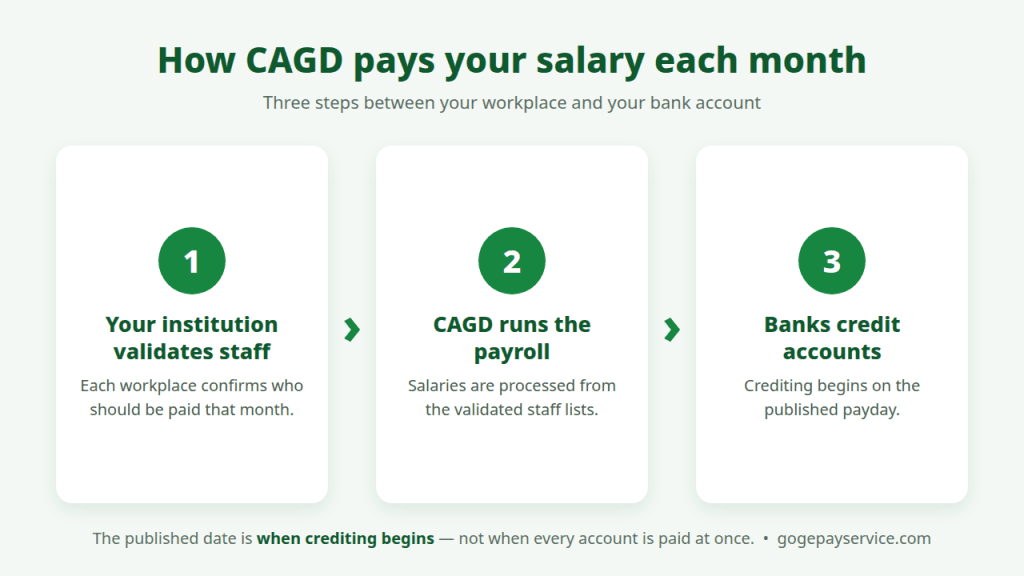
Every month, CAGD processes salaries for civil servants, Ghana Education Service staff and other public sector workers on the government payroll. Your institution first validates its staff list, then CAGD runs the payroll, and banks start crediting accounts on the scheduled date. That is why the published date is the day crediting begins. It does not mean every account is credited at the same hour. If CAGD changes a date, it announces the change through its official channels.
The cycle starts at your workplace. Each month, your institution confirms which staff should be paid: who is at post, who is on leave, who has transferred, who has left. CAGD then processes the payroll from those validated lists and releases funds to the banks. Because validation happens institution by institution, a delay at your workplace can delay your pay even when the national date is met. Two workers can have different experiences on the same payday. The national date is fixed, but each person’s pay depends on their own institution’s validation going through cleanly.
Full 2026 salary payment schedule
Month | Payment Date | Day |
|---|---|---|
January | 23 January 2026 | Friday |
February | 26 February 2026 | Thursday |
March | 26 March 2026 | Thursday |
April | 27 April 2026 | Monday |
May | 26 May 2026 | Tuesday |
June | 26 June 2026 | Friday |
July | 27 July 2026 | Monday |
August | 27 August 2026 | Thursday |
September | 25 September 2026 | Friday |
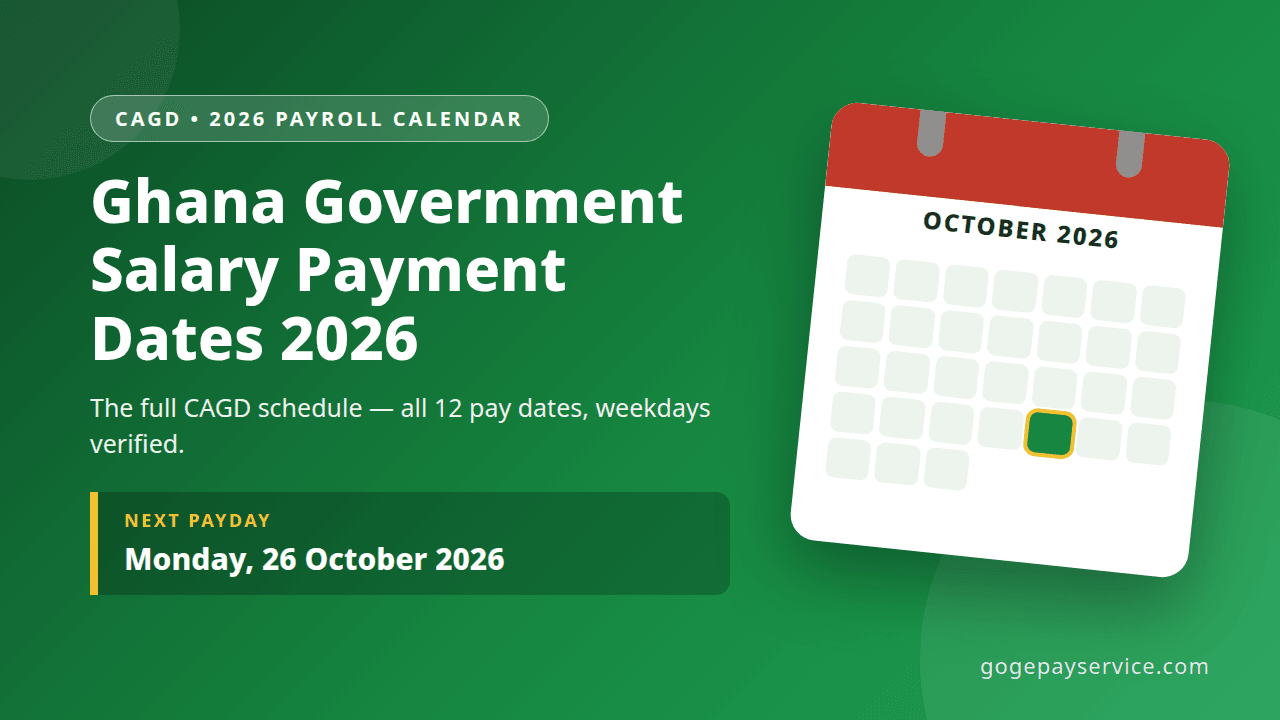
October | 26 October 2026 | Monday |
November | 25 November 2026 | Wednesday |
December | 21 December 2026 | Monday |
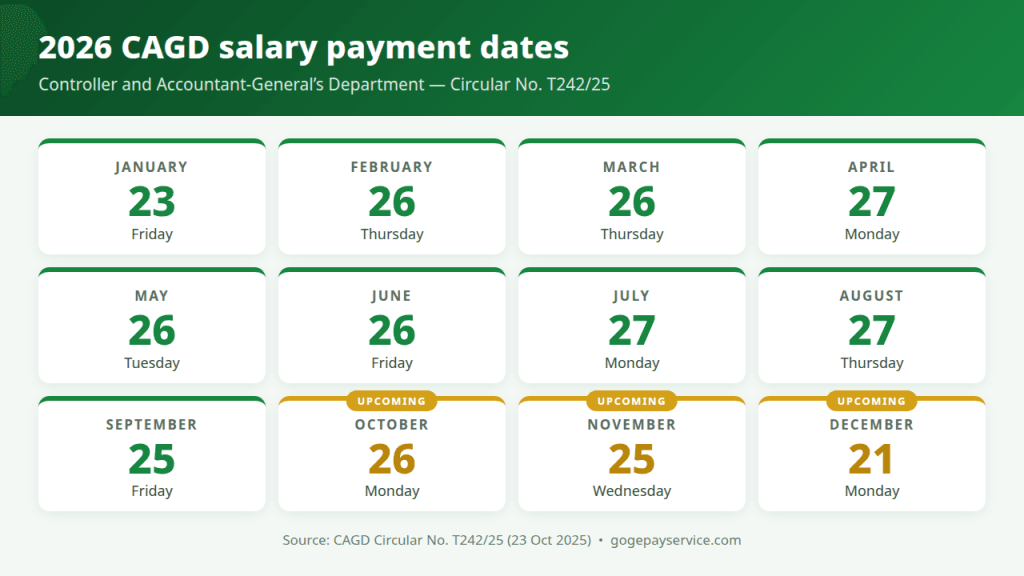
Remaining payment dates for 2026
- October salary: Monday, 26 October 2026
- November salary: Wednesday, 25 November 2026
- December salary: Monday, 21 December 2026 (earlier than usual, ahead of the Christmas period)
Why the dates fall where they do
Most 2026 paydays fall between the 25th and 27th of the month, and every one lands on a working day. The schedule avoids weekends. December is the planned exception. Salaries go out on 21 December, earlier than usual, so workers are paid ahead of the Christmas period. This early December payment is CAGD’s normal annual practice.
What these dates mean
The date is when banks start processing and crediting salaries. It is not a guarantee that every account is credited at the same time. Banks work at different speeds, validation can be late at your institution, and payroll corrections happen. Your salary can arrive hours, sometimes a day, after a colleague’s. A delay of a few hours on payday itself is normal. It does not mean something is wrong.
The published date is when crediting starts. Most workers see the credit the same day. Some see it the next working day. Only when the delay goes beyond that, or your ePayslip for the month never appears, should you treat it as a problem to chase.
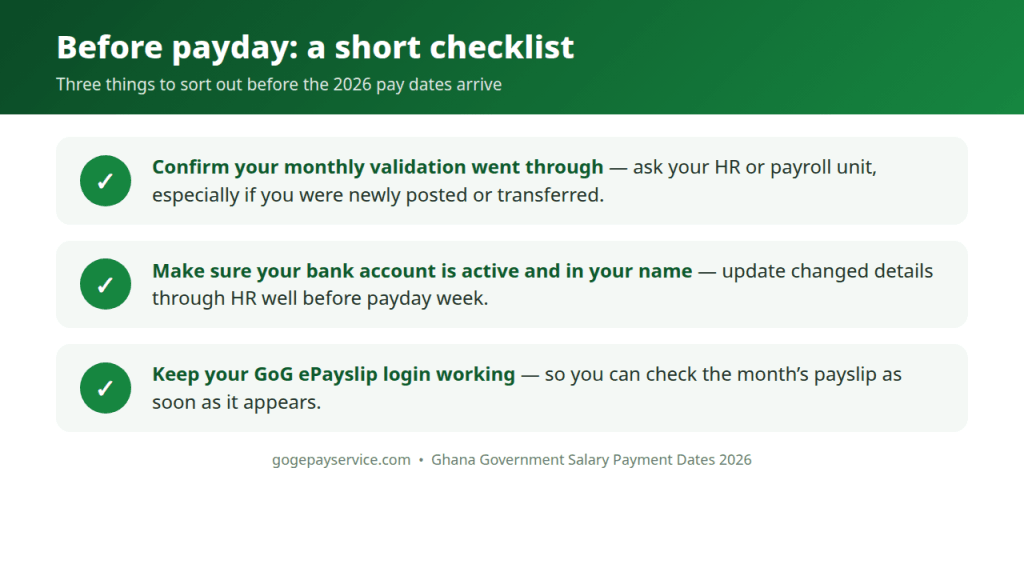
Before payday: a short checklist
Payday goes smoothly for most workers. A little preparation avoids most problems:
- Confirm with your HR or payroll unit that your monthly validation went through, especially if you were newly posted, transferred, or are returning from leave.
- Make sure the bank account CAGD pays into is active and in your name. If you changed banks, update your details through HR well before payday, not during payday week.
- Keep your GoG ePayslip login working so you can check the month’s payslip as soon as it appears.
Planning your bills around payday
Because banks start crediting on the published date instead of finishing every payment at once, do not schedule critical debits for payday morning.
- Set standing orders, loan repayments and automatic transfers for one or two working days after the scheduled date.
- Keep a small buffer in your salary account so a late credit never causes a failed debit or a penalty.
- Plan December carefully. Salary arrives on 21 December and the next payday is several weeks away, so stretch the December salary across the festive period and the longer gap that follows.
If your salary or payslip is delayed
- Check that monthly validation for your institution was completed on time. Staff who were not validated are left out of the payroll run.
- Log in to the official GoG ePay Services portal and check whether your ePayslip for the month has been generated. See our check ePayslip guide
- If the payslip is there but the bank credit is not, give it one working day and check with your bank first. Crediting times differ between banks.
- If there is no payslip at all, or the amount is wrong, contact your HR or payroll unit with the month, your employee number and a copy of the previous payslip.
- Keep your own record. Note the date you checked, what the portal showed, and who you spoke to at HR or the bank.
- Never share your password, OTP, staff number or Ghana Card details with anyone offering to “fast-track” your salary.
Related guides
- Check or download your ePayslip — https://gogepayservice.com/check-epayslip/
- Estimate your take-home pay — https://gogepayservice.com/net-salary-and-tax-calculator/
- Problems logging in or missing payslip — https://gogepayservice.com/troubleshooting/